1
Snap it — or pick it
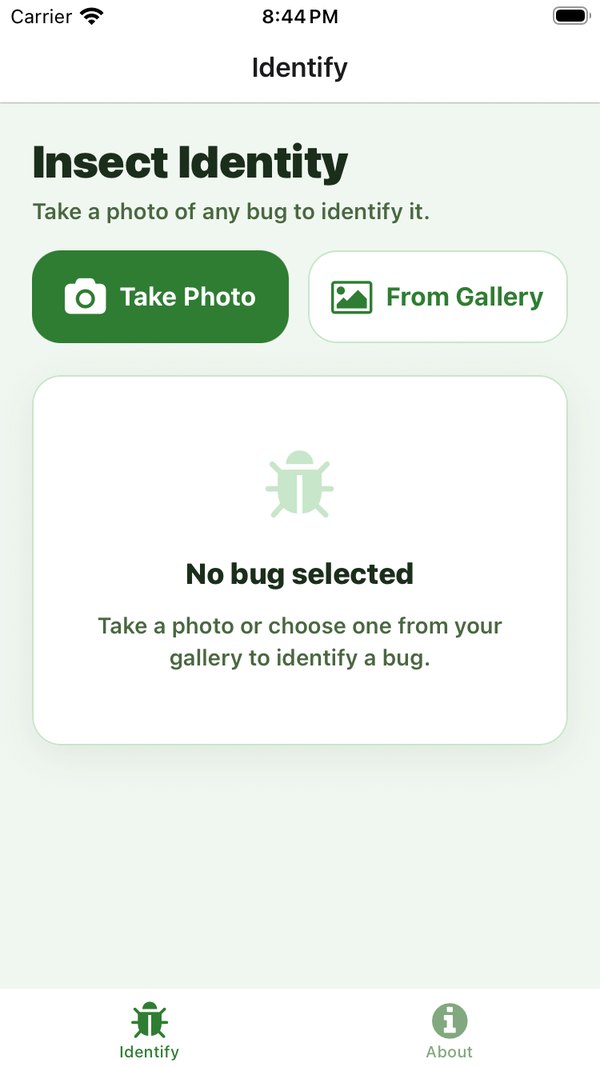
Take a photo right there, or pull one from your gallery. Yesterday's mystery bug counts too.
 Insect Identity
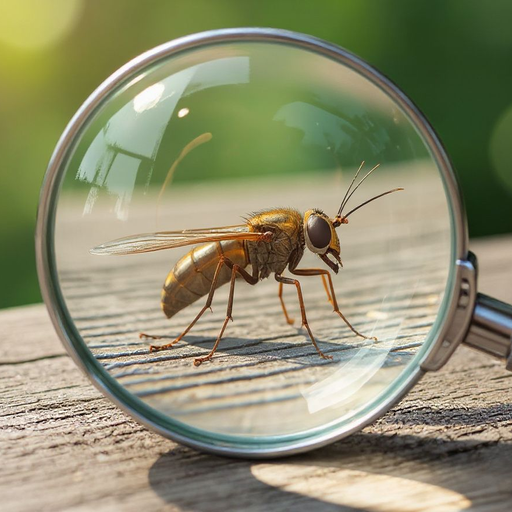
Snap a photo — or pick one from your gallery — and the AI inside the app answers in about a second: the species, an honest confidence score, and whether it can actually hurt you. It knows 224 species, it runs entirely on your phone, and it works with no signal at all.


Tap a bug to identify it
Illustrative demo of the app's result card — in the app, results come from your own photo.
One photo, about a second of thinking, and no signal required.
Take a photo right there, or pull one from your gallery. Yesterday's mystery bug counts too.
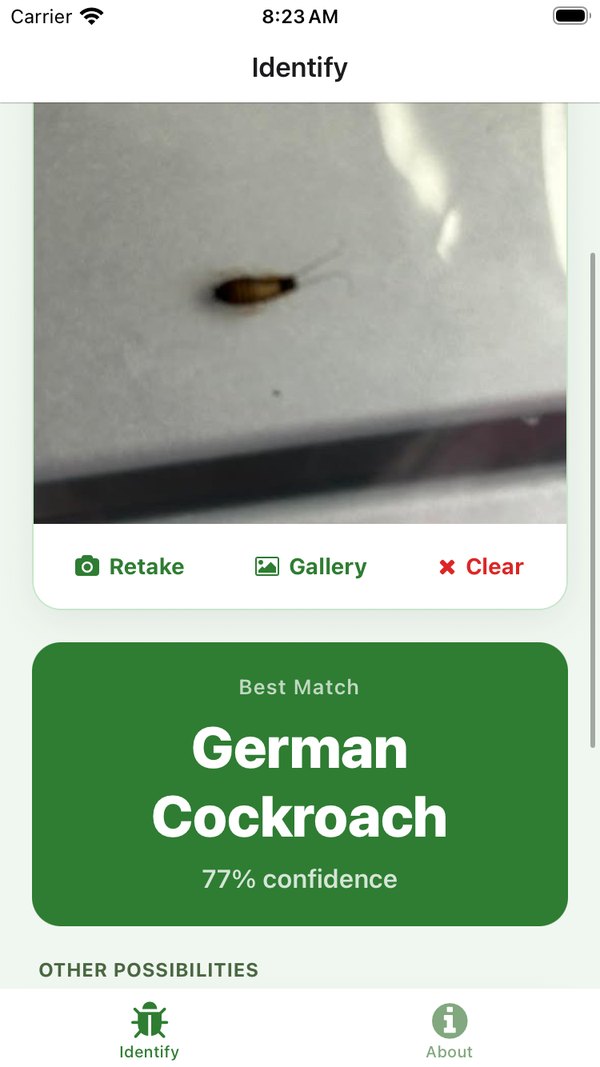
The species, a confidence score, and a risk badge: harmless, irritates skin, may bite, can sting, or can be dangerous — with first aid when it matters. Most of the time it is harmless, and the app says so plainly.
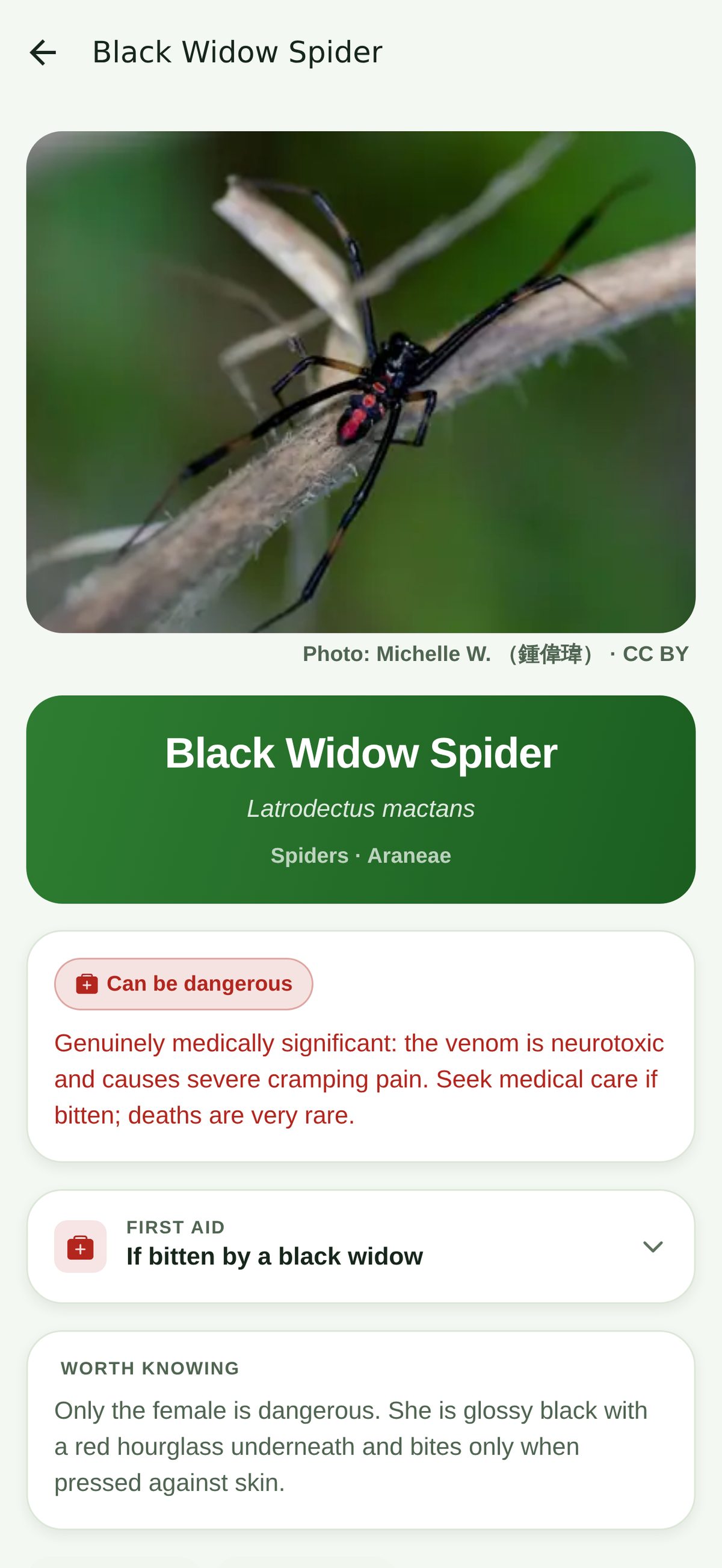
Scientific name, size, diet, habitat, when it's active, and the one thing worth knowing — for every one of the 224 species, offline.
Not ten thousand obscure taxa. The model is focused on the insects, spiders and ticks people run into at home, in the garden and on the trail.
Monarch, swallowtails, luna & cecropia moths, painted lady, hawk moths…
Japanese beetle, fireflies, stag & click beetles, seven-spotted ladybug…
Honey bee, bumble bees, yellowjackets, paper wasps, European hornet…
House fly, horse fly, crane fly, hoverflies, tiger & house mosquitoes…
Green darner, whitetails, skimmers, bluets, ebony jewelwing…
Grasshoppers, katydids, field crickets, walking stick, praying mantises…
Stink bugs, squash bug, spotted lanternfly, cicadas, water strider…
Cockroaches, bed bug, silverfish, clothes moth, carpet beetles, ants, fleas…
Black widow, brown recluse, wolf & jumping spiders, deer and dog ticks…
Honest by design: if you find something rarer, the app gives you its closest common lookalike — with a confidence score low enough to say so. An ID app that's always sure is lying to you.
Every identification is a probability, and the app treats you like you can handle that. The best match comes with its confidence score, the runners-up come with theirs, and a blurry photo scores low instead of pretending.
A real result, straight from the app
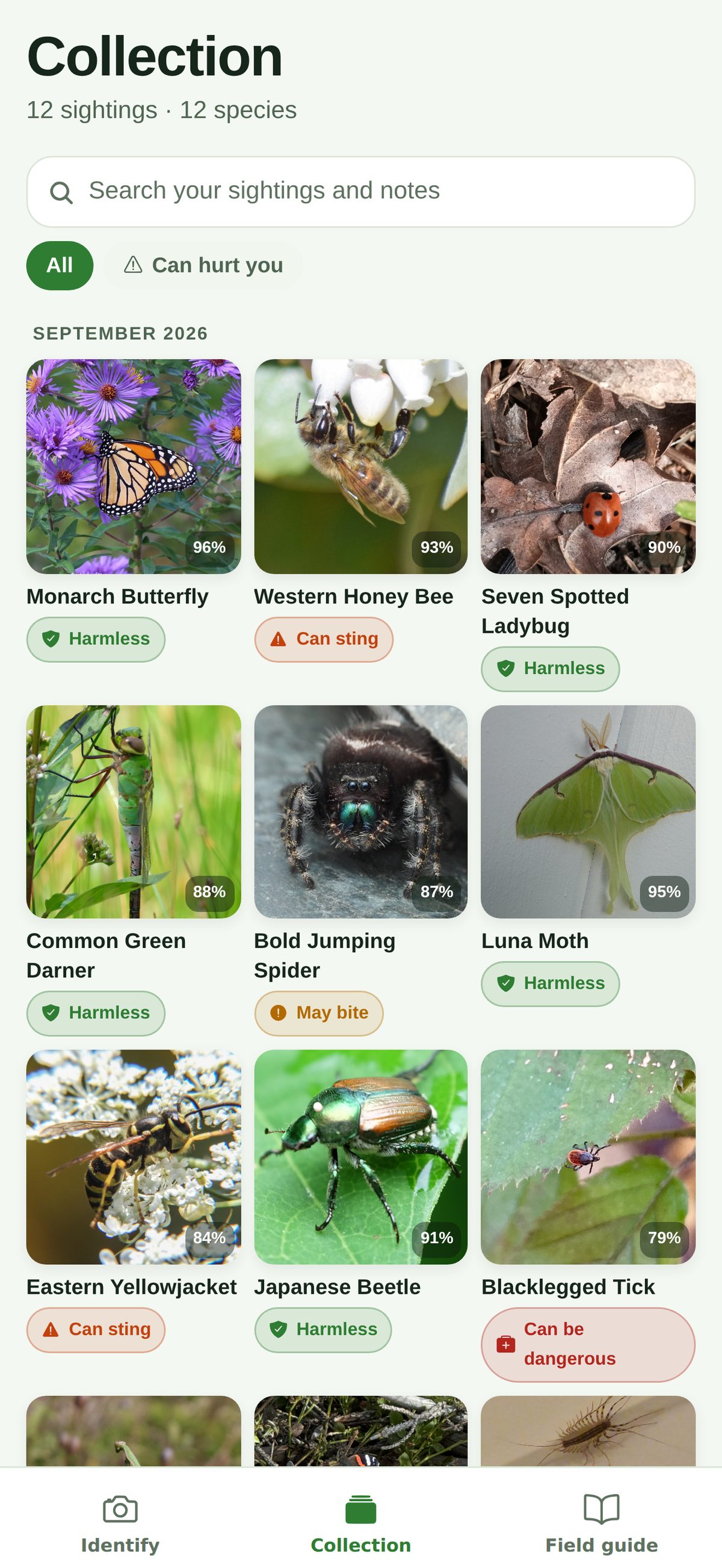
An identifier you use once is a toy. This one keeps a record.
Every identification is saved with its photo, the date and the confidence — a running record of your garden, your hikes, your house.
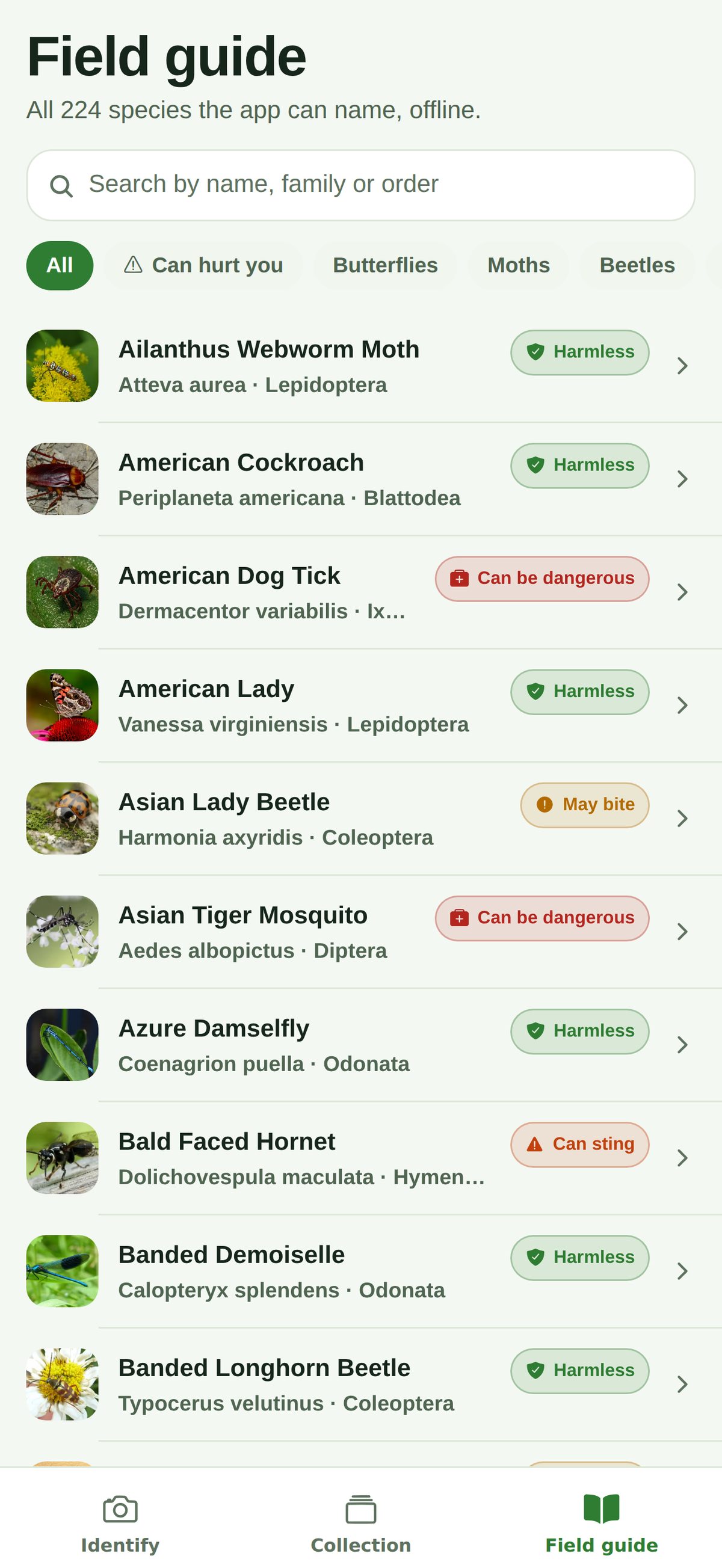
Browse or search the entire field guide without taking a photo at all. Filter by group, or by whether it can hurt you.
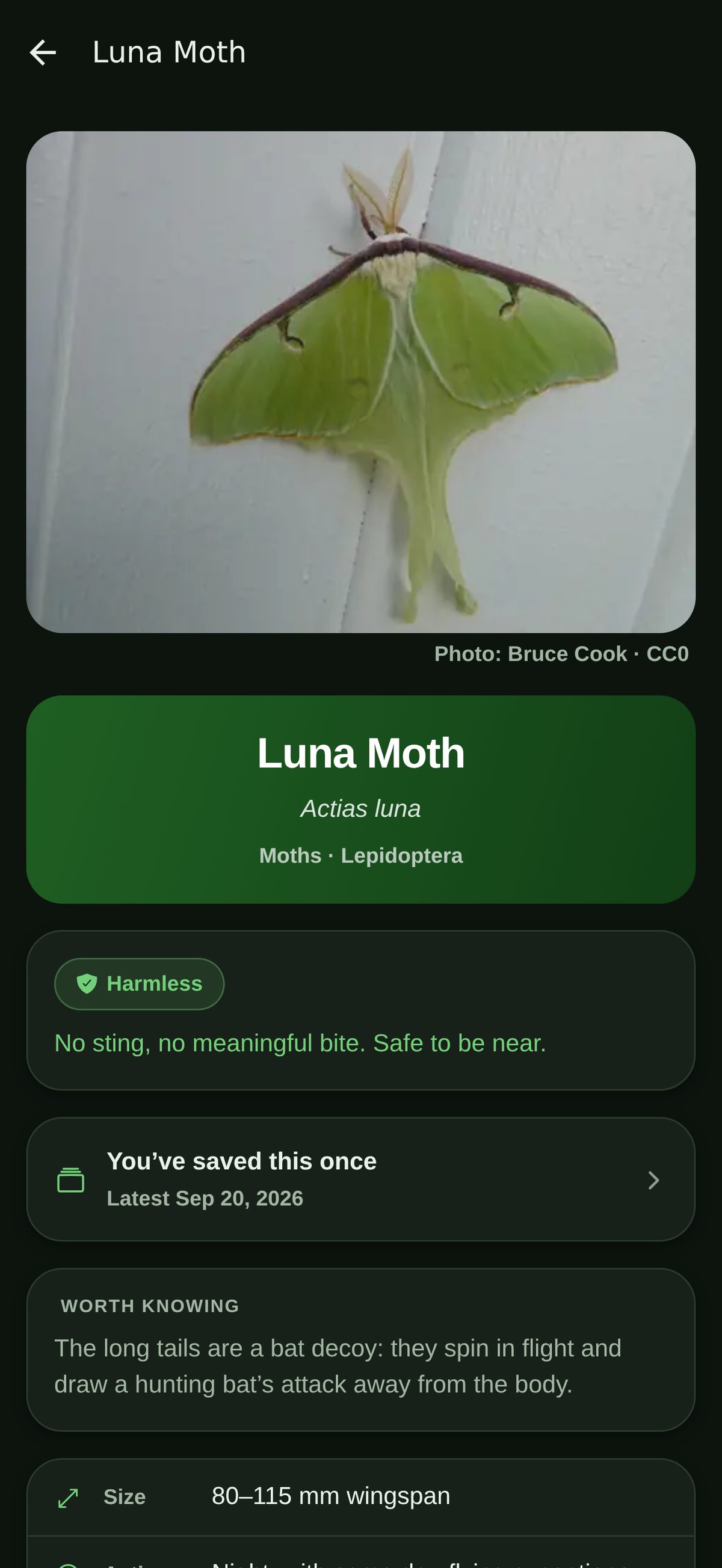
A proper dark theme for the moment something appears on the ceiling and you would rather not be flashbanged by your own phone.
224 common species across the bugs people actually meet: butterflies, moths, beetles and ladybugs, bees, wasps and hornets, ants, flies and mosquitoes, dragonflies, grasshoppers, crickets and mantises, true bugs and cicadas, household pests like cockroaches, bed bugs and silverfish — plus spiders and ticks. It's tuned to common North American and European species; a rare find may come back as its closest common lookalike, with a low confidence score to match.
It never pretends to be certain. Every result is a best match with a confidence score, followed by the runners-up. A sharp, close, well-lit photo usually scores high; a blurry one scores low and the app shows you exactly how low. Treat any result as a strong lead, not a verdict — and never rely on it alone for decisions about stings, bites or eating anything.
Yes, completely. The neural network ships inside the app and runs on your phone's own chip. Identification works in airplane mode, deep in a forest, or in a basement. Only the optional ads need a connection.
They stay on your phone. Analysis happens on the device, so the photo is never uploaded anywhere. There is no account and no sign-up.
Ads (via Google AdMob) keep the app free — a small banner and an occasional full-screen ad. On iOS you'll be asked for App Tracking Transparency permission; declining just means the ads aren't personalized.
Yes — the app supports both iPhone and iPad, and the Android version runs on phones and tablets. The model is identical on every device.
Works offline. Photos stay on your phone.